
I was watching “Look Back” for the second time, and showing it to my 6 year old daughter, and 3 year old son, hoping to inspire them, have them FEEL, think about the characters, what it means to have a dream, passion, rigor, challenges, what it means to navigate through loss, and have them indulge in some introspection.
The second go around (after watching it with my wife in theaters years ago) impacted me even more. I found myself choked up on several scenes that did not hit me the same way on the first viewing. Perhaps knowing the Shakespearean tragedy awaiting Kyomoto and Fujino, the whole movie felt more poignant, viewing scenes through a different lens.

Even the scene with Fujino cheering in the rain as a kid, after Kyomoto said she loved her manga, put a frog in my throat. I told my kids, days like that don’t often happen, and they seem to happen less the older you get. So seek them out, look for challenges, adventures, connect with people and bond, lean hard into what scares you, what excites you, and CHERISH the days where you confront your inner storm. They will be the moments and memories that sustain you for a life time, as you “look back”, especially through the hard times.

All three instances where the manga strip floats under Kyomoto’s door, a quantum threshold, smacks of schrödinger’s cat especially when in one reality Kyomoto has already been killed. But then is Kyomoto back in her room when the manga strip floats back to Fujino with a new skit entitled “Look Back”? Could it be? A different time line? An alternate possibility? A different Kyomoto? A miracle? Magic? Please, please, please, let it be true! We bargain desperately in our grief… Separated from Fujino by a mere wooden door, Kyomoto is both living and dead, in a state of superposition, until we open the door and determine the version of this reality.
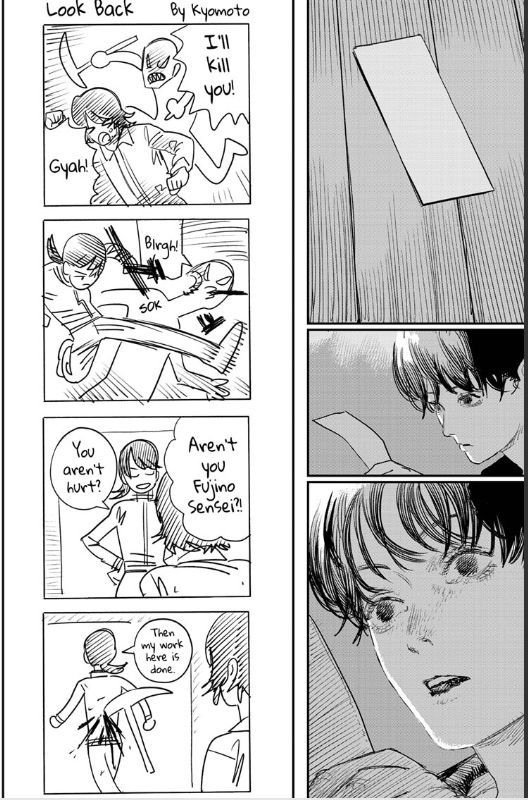

This ties into the door that Kyomoto is painting at her art school, in a timeline that exists at the periphery of Fujino’s mind’s eye, where Kyomoto isn’t killed. This emblematic door is the fork in the road for her life, where Kyomoto decides whether to leave and brave the world, or stay in her room nice and safe, and complacent, and stagnant. But despite all the warnings and risks, fears, and doubts, a young Kyomoto bursts through the door after Fujino, opting to live instead of survive. Upon passing through the threshold, the cogs of fate are set in motion.

I knew right then and there, I had to write about “Look Back”, with a focus on the last act of the film, Fujino and Kyomoto’s relationship, and their eventual “breakup”. When Kyomoto decides that she no longer wants to chase Fujino, but stand side by side with her, and this requires her to part ways and forge her own path and reject the chance to serialize a manga with Fujino.
Fujino’s worst fear realized.

Fujino tries desperately to squeeze onto Kyomoto, saying that Kyomoto won’t be able to assert herself, function, or live without Fujino to guide her. Fujino’s attacks are a projection of how she actually feels about herself and her codependency with Kyomoto. Fujino wants and needs Kyomoto by her side, because without Kyomoto she will be alone again, with nothing. Fujino’s irrational fears and lack of confidence manifest as panic, anger, an unfair sense of betrayal, and selfishness. Rather than being honest about her feelings and leaning into what scares her (something Kyomoto represents and models so well throughout the movie and manga), Fujino pushes Kyomoto away.

Ultimately, Fujino does not tell her best friend how much she loves her, and will miss her, or how scared and sad the prospect of going their own separate ways makes her feel… And tragically, Fujino never will. She will never get to tell Kyomoto that despite her fears and insecurities, she will continue to cheer Kyomoto on, and encourage her to pursue her dreams to become a better artist because that is what is best for Kyomoto to grow, and learn, and be whole. That even though it hurts, she wants the best for her friend.
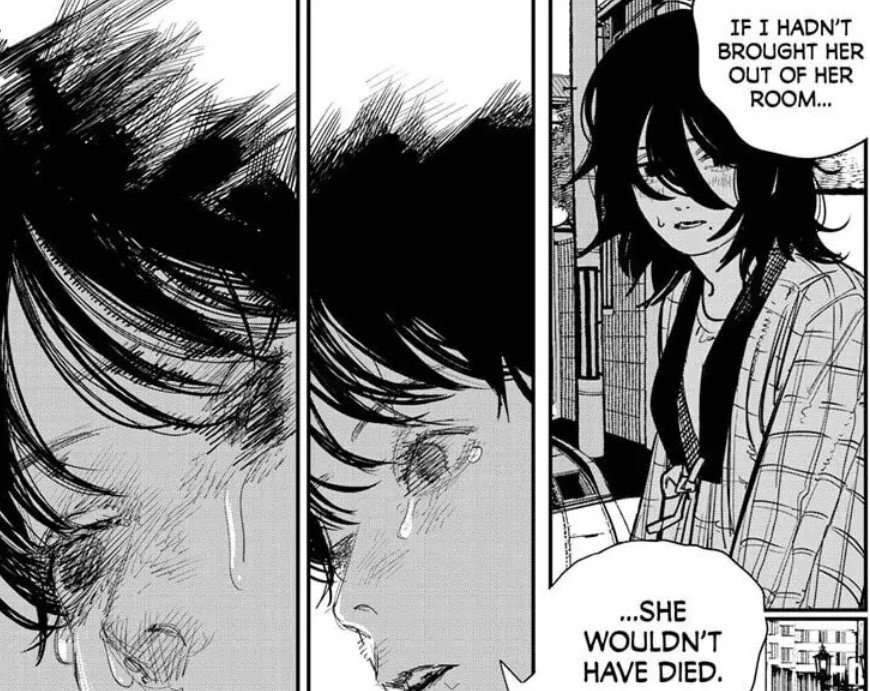
Fujino blames herself for Kyomoto’s death, thinking that Kyomoto never would have left her room, and would never have been murdered, if Fujino hadn’t inserted herself into Kyomoto’s life when she was delivering the diploma. Fujino curses manga which can’t save lives, that it has no merit, no value. In a moment of anguish and guilt, the grieving Fujino discredits Kyomoto’s resolve, courage, and dedication to her craft, robbing Kyomoto of her agency. But we know, through the quantum shadow of an alternate reality, that Kyomoto eventually leaves her room anyway, even without Fujino’s intervention. This nervous, pitiful, coward, who always rises to the occasion, overcomes fear with bravery, speaks honestly from her heart, and doggedly pursues her dream, is nothing to pity.

After one final “Look Back” Fujino finds herself staring once more at Kyomoto’s back. That is to say, the back of Kyomoto’s old robe which is enshrined on the door to Kyomoto’s room, and adorned with Fujino’s autograph which she signed as a kid during their first encounter. Frozen in a different and inaccessible point in the past, the person whom Fujino admired most, and was constantly chasing from behind, obsessively reading through art improvement books and filling up sketch pads with drawings, year after year after year, all in an effort to improve her skills as a manga artist and catch up to Kyomoto.


Alone, in a room silently stirring with charged liminal energy, of a thing which cannot be put back, or made right again, Fujino reconciles her feelings and her relationship with Kyomoto.

There is nothing to regret. Nothing to feel guilty about. Nothing left to understand. Nothing to pity. Nothing to fix.
What else is there to do, or say, or think?
Except to feel honor, and nostalgia, and love, and feel pride for your best friend, even through tears and a deep choking grief that compels you to your knees.
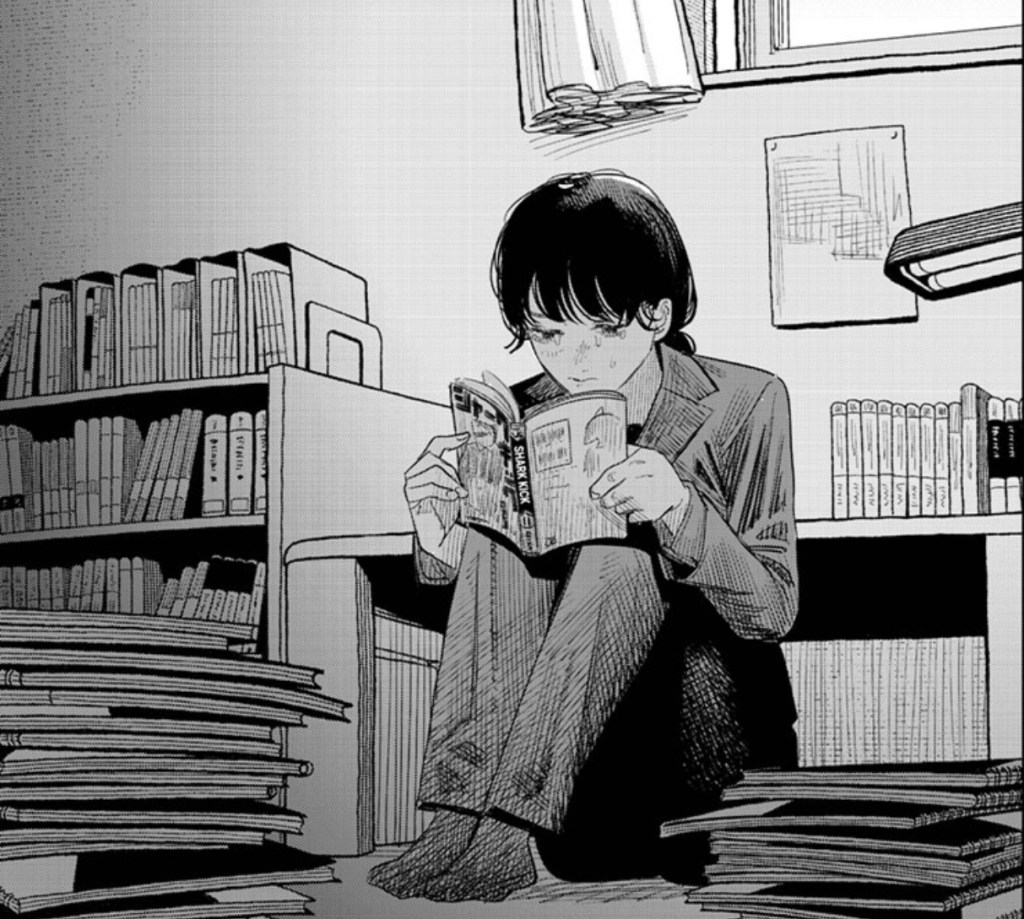

With nothing left but to say good-bye and move forward, Fujino must now leave Kyomoto’s room. By herself. Her greatest fear. Like their last meeting where they marched down diverging paths, lonely footsteps crunching snow into the cold silence of a truth that was never spoken.
Which doesn’t really matter, doesn’t change anything, what they shared and experienced, nor how they truly felt. Because the foundation of this relationship is unfettered admiration and love for the other, with both of them thinking they are chasing the other. But we bystanders on the outside looking in? All we see, and all we ever saw, are two passionate artists, rivals, muses, best friends… sitting side-by-side, shoulder-to-shoulder, hand-in-hand, on a train. Whispering, laughing, and going the same direction, to the same terminal stop.

And them not parting ways for the final time with a hug, and a tearful farewell doesn’t change that truth. CAN’T change that truth. That beautiful, wonderful reality. Kyomoto is Fujino’s biggest, unconditional, number one fan. The same is true of Fujino’s feelings for Kyomoto. Kyomoto is the love of her life. Her light.

*queue “Light Song” by Haruka Nakamura & Urara”*
Even though it is sad how it ended, as many final farewells often are, wasn’t it beautiful? Wasn’t it worth it? To answer Kyomoto’s question with another question, wasn’t the time they spent together, toiling over manga, a good enough reason “why”? Given the chance, wouldn’t they do it all over again?

Through reincarnation, quantum mechanics, the multiverse, magic, causality, memetic or biological legacies, the one constant in the karmic universe is that those two, no matter the distance, the time, through disasters, or trauma, through blockers, and barriers, they will find eachother again. Even if a meteor crashes into the Earth.


Fujino must now find the courage to leave Kyomoto’s room, just as a younger, shy, trepidatious Kyomoto once did, chasing feverishly after Fujino. All because a four panel manga strip, guided by the winds of fate, impossibly found its way gliding under Kyomoto’s door, which sends them down a path that changes their lives forever.

Fujino does find the wherewithal to leave Kyomoto’s room and go home. She begins to work on her manga again, taping a manga strip labeled “Look Back” onto her window above her work area. Surely, Kyomoto looking over her until they can meet again.

Except now the four panel manga strip is empty, the panels blank.
This is reality.
All possibilities collapse into the singularity, a life without Kyomoto.
The sun rises and falls on the horizon.
Life goes on.
The hiatus is over.


 Anime Sunday
It’s like diving into a Newtoki webtoon – sometimes you’re left hanging, and other times you’re just grateful for the moments that do come. Life, just like anime, has its unpredictability, but it’s the surprises that make it worth the wait.
LikeLike
haha! right the Newtokii. I remember this was my favorite webtoons.
LikeLike
look back was so devistating
LikeLike